
Sizing a cylindrical tank from a target capacity
Where the numbers come from in the tank calculator, and which of them are worth checking by hand.
Capacity fixes the product of cross-sectional area and height, which leaves the diameter-to-height ratio free. That choice is where the engineering sits.
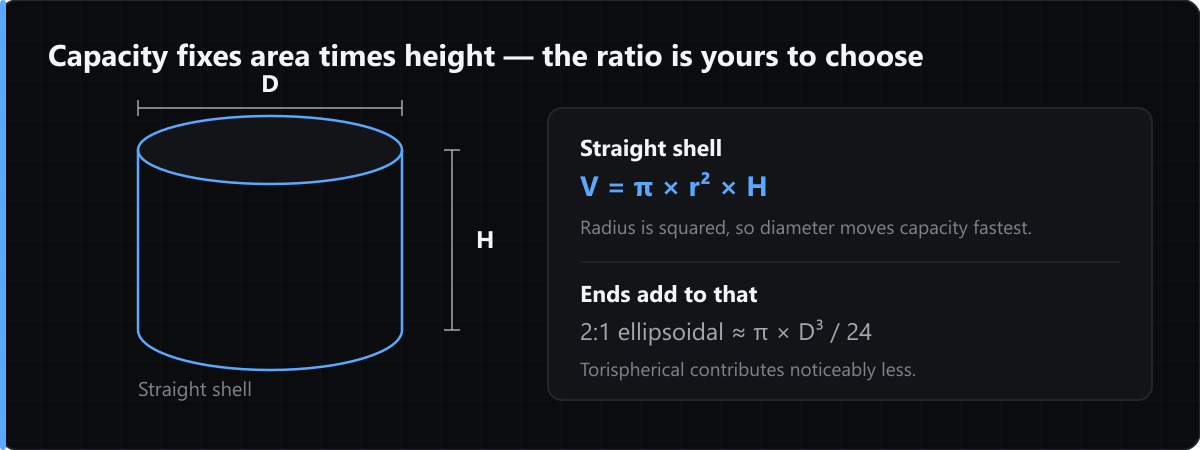
The straight shell
For a vertical cylinder, volume is π × r² × h. Because the radius is squared, a small increase in diameter buys a large increase in capacity — halving the height of a tank requires only about a 41% increase in diameter to hold the same volume.
The ends
Dished and conical ends add capacity beyond the straight shell, and the amount depends on the head type. A 2:1 ellipsoidal head contributes roughly π × d³ / 24; a shallower torispherical head contributes noticeably less. On a short, wide vessel the heads can be a significant fraction of the total, which is why the calculator asks for the end type rather than assuming one.
What the calculator does not decide for you
Plate thickness, corrosion allowance, nozzle placement and the applicable design code are all outside it. Treat the output as a starting geometry for sizing and material estimation, and confirm it against your drawings and code before ordering.